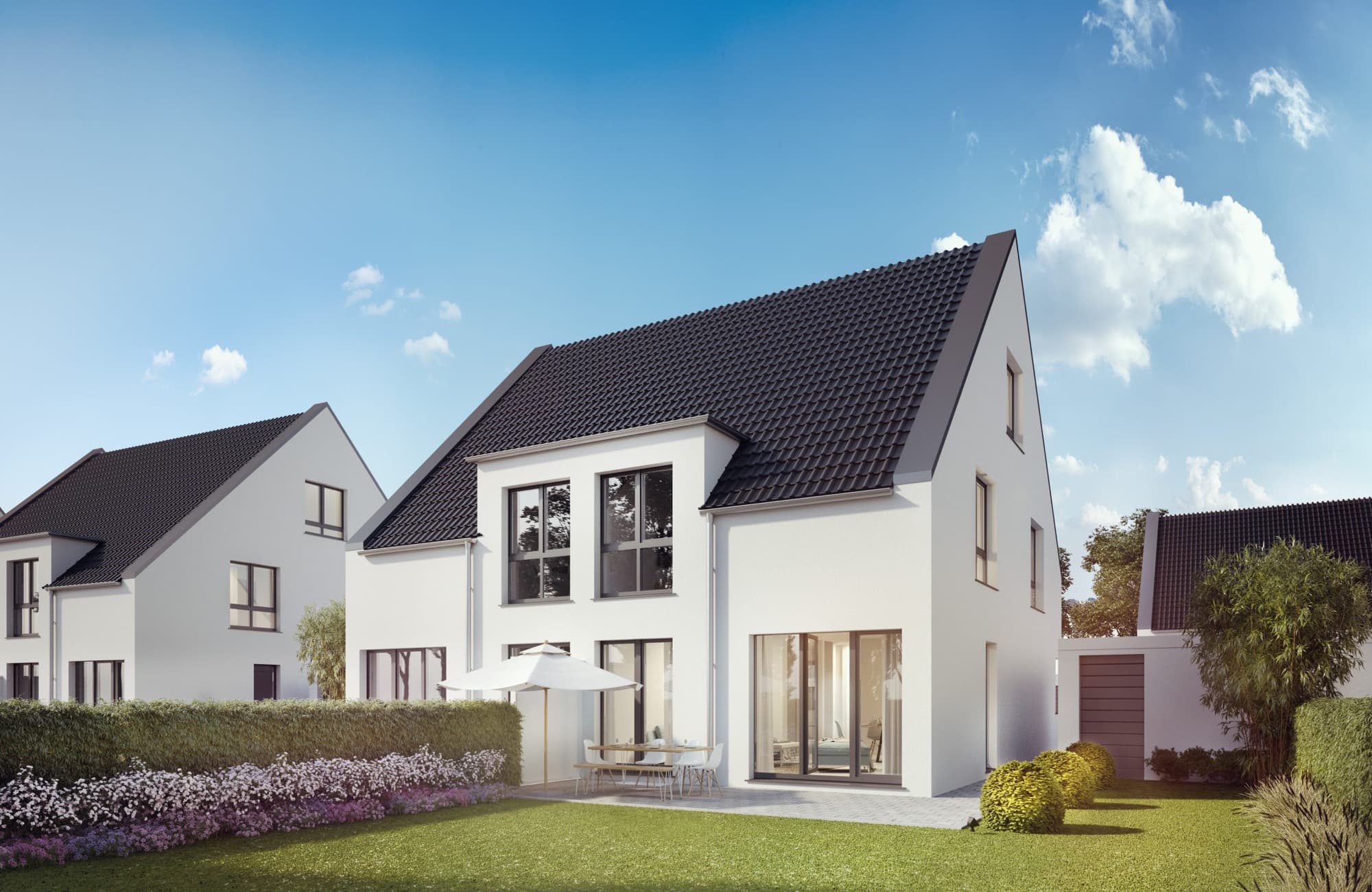
Three construction phases in the “Auf dem Zanger” development area in St. Hubert are complete. 24 semi-detached houses, which the Tecklenburg company built according to the “Himmelblau” concept, are occupied. The so-called neural network is proving its worth. So far the modern heating system has run without any faults.
For the town of Kempen it is an experiment: in St. Hubert, a residential development is currently taking shape in the new-build area “Auf dem Zanger”, with a joint energy concept devised by the town administration, private developers and the Kempen municipal utilities. The utilities had a small combined heat and power plant built with a solar thermal system and heat pump specifically for this purpose. From there the houses are supplied with district heat and electricity. The Tecklenburg construction firm from Straelen developed a model for this development with its “Himmelblau” concept. We visited a family already living in a new home in the development. When Kathrin Sanders walks toward the house she and her husband Daniel have lived in since early May, pushing the pram, she may not be too keen on the dirt she tracks into her own four walls when crossing the construction road, but she beams when she looks at her new home. “It was love at first sight when we were here for the first time back then for the shell viewing, and nothing has changed about that. We really enjoy living here and feel very much at home. And that thing with the construction road will come to an end at some point too,” says the young woman with a smile.
In May, the couple was the first family to move into the second construction phase of Tecklenburg's “Himmelblau” project in St. Hubert in the “Auf dem Zanger” new-build area. Six semi-detached houses from the company's first construction phase had already been occupied by then, and eight belonged to the second phase. For the Sanders family, it did not take long before the other neighbours had moved in and everyone got to know one another. “It is relaxed living. Since we moved here, we no longer drive to do our shopping. Everything is within walking distance. You live quietly and yet centrally,” is how Kathrin Sanders describes the new sense of living, which differs markedly from that in the rented flat in Krefeld where she and her husband lived before buying the house and moving to St. Hubert. In the “Himmelblau” development area, the first three construction phases by Tecklenburg, all semi-detached houses, are completely finished and occupied. The houses of the fourth phase are currently being handed over. At number five, the apartment building, work has just begun on installing the windows in the shell, and at construction phase six, again semi-detached houses, the shells are likewise complete. The roofers are at work there.
Under the cheerful project name “Himmelblau”, the first groundbreaking ceremony for the “Auf dem Zanger” new-build area in St. Hubert took place in April 2019. Between the Wackertapp mill and the existing residential development “Auf dem Zanger”, this marked the starting signal for converting farmland into property for home builders. Divided into six phases, the Straelen construction company set about building a total of 42 semi-detached houses as well as the apartment building with 20 barrier-free condominiums. On the plots, each measuring 250 to 350 square metres, the company built one-and-a-half-storey single-family houses with a basement, in sizes ranging from 128 to 133 square metres of total area. On top of this comes the basement area of around 56 square metres.
A special feature is the energy supply. For the new-build area, a special supply concept was developed in cooperation with the Düsseldorf University of Applied Sciences and the Kempen municipal utilities, in which the university developed the control system for the plant, which works with artificial intelligence. Electricity and heat losses can thus be minimized. A dedicated energy hub, which produces electricity and district heat simultaneously, was built in the residential area. The plant combines several forms of generation. On the one hand there are solar thermal collectors to generate heat from solar energy, and on the other a heat pump to use geothermal energy. In addition, there is a small gas-powered combined heat and power unit for coupled electricity and heat generation, as well as a heat storage unit with an electrode heater for energy optimization. The new heating hub works with a so-called neural network. This ensures that only the energy actually needed is made available. In the houses themselves, the modern supply is also noticeable in the utility connection room. “Everything is totally smart,” says Kathrin Sanders, pointing to the flat box on the wall behind which all the technology is concealed. Not a space-consuming heating system, but a small box, no bigger than the electricity meter box. This way the room can be used optimally as a utility room with a washing machine and dryer. There are also requirements beyond the energy supply.
The front gardens of the development area must be planted with greenery. Gravel gardens are prohibited by the town. The construction company is satisfied with the implementation of the project. “We are well on schedule. Corona is an issue that keeps us busy organizationally, but does not set us back. The last houses are to be handed over in May 2021,” says Stephany Cox, Tecklenburg's head of sales.
Source: RP