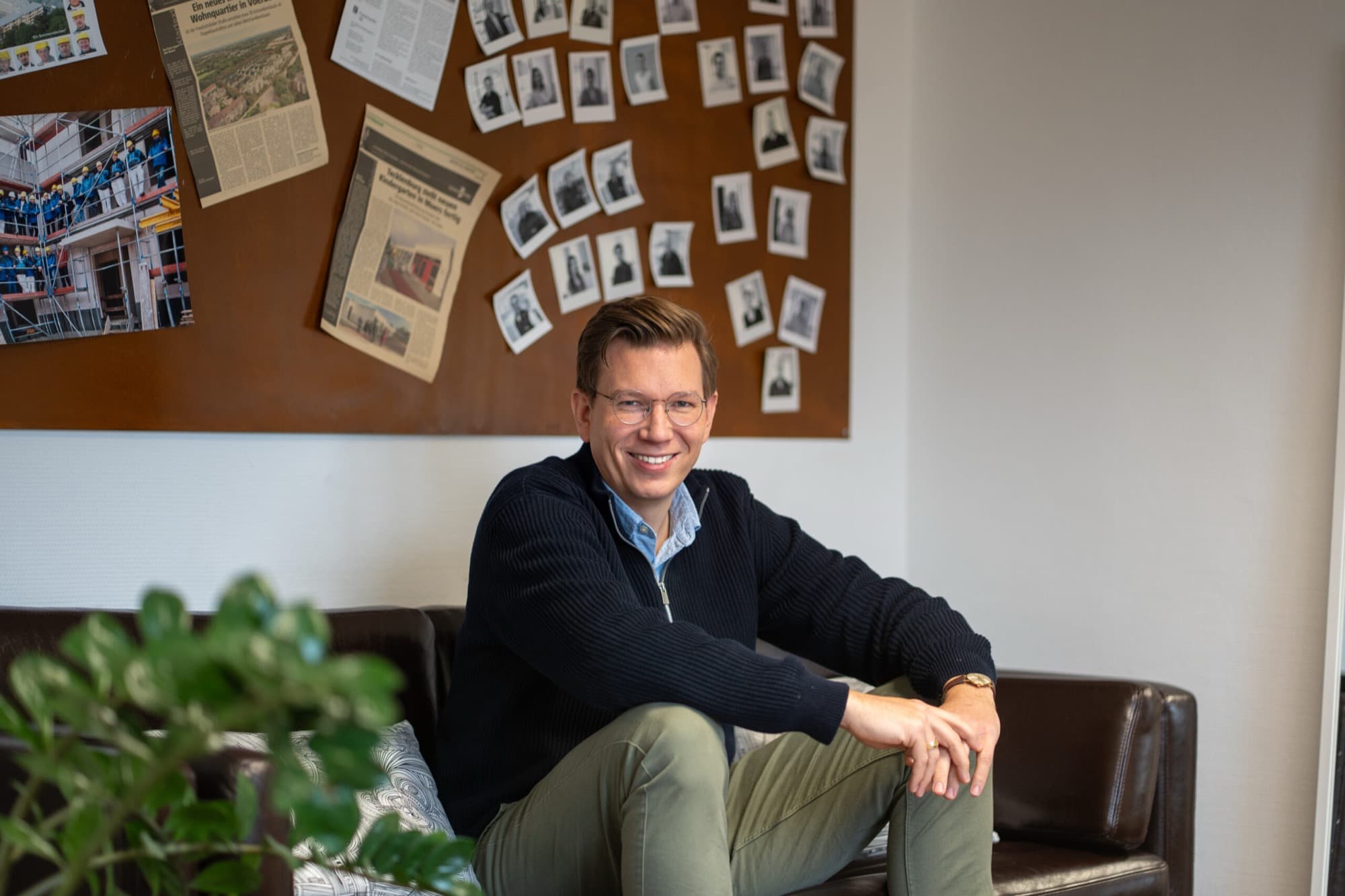
1. What does corporate transformation in the construction industry mean in concrete terms – and how does it show up in your day-to-day work at Tecklenburg GmbH?
Corporate transformation means aligning the company strategically with future market requirements; it spans several dimensions such as strategy, culture, business model, technology and processes. At Tecklenburg, this includes identifying and developing new business areas such as timber modular construction, advancing existing models such as the general contractor business, as well as optimising and digitalising processes, ways of working and structures.
A central element is observing, understanding and assessing the market and relevant trends: Which developments are relevant to us as a company and employer? What impact could they have on our organisation, our customers or our projects?
In my everyday work, this shows up through working on strategic projects in various interdisciplinary teams. It is not only about implementing new ideas, but also about developing existing structures further and enabling the organisation to embrace change. Tasks here include, for example, automating processes, synchronising processes and digital solutions with the Geiger Group, or contributing to the corporate strategy.
2. How do you identify which topics or business areas hold particularly strong future potential?
Together with our colleagues from the Geiger Group, we are working on a corporate strategy that enables us to make targeted use of synergies within the group and to make them visible in the market.
We engage intensively with megatrends – such as digitalisation, sustainability or demographic change – and analyse the impact these have not only on our products and services, but also on us as an organisation and as an employer.
Another important factor is our network: the regular exchange with partners, customers and other players in the industry helps us to recognise early on what is moving the market. Fortunately, the era of elbow mentality in construction is over – today, knowledge is shared, and that is exactly what benefits the industry.
This gives rise to new business models, enhancements of existing offerings and also impulses for internal processes. The combination of market observation, group know-how, network and internal expertise is a central success factor.
3. What role do innovations and new technologies play in the strategic development of a construction company?
The influence of innovation and technology can be viewed from two perspectives. On the one hand, we actively use them in our pursuit of continuous improvement: to optimise processes and structures, make them more transparent and increase our value creation. New technologies enable more efficient workflows and make processes and business models measurable. This is crucial for making data- and fact-based decisions – both at the operational and strategic level.
On the other hand, innovations and technological developments are often the result of external influences and pressures. They arise from societal, ecological or economic developments and thus shape not only our company, but the entire market. One example of this is the megatrend of eco-intelligence: it significantly drives sustainable technologies and construction methods and influences the entire industry. Innovations and new technologies therefore strongly shape our development.
4. How do you manage the balancing act between tradition and modernisation in construction?
We respect our origins as a family business rich in tradition and combine them with a clear orientation towards the future. Since this year, we have been part of the Geiger Group – a corporate network that has been successfully living out this balance between tradition and innovation for years. This gives us additional impulses and opportunities to take new paths without losing our identity.
Many of our employees have been with the company for many years and identify strongly with Tecklenburg. At the same time, we are open to the constant change in the industry and actively help to shape it – whether through new business models, modern construction methods or digital ways of working. In doing so, it is important to us not to lose sight of our values such as reliability, quality and collaborative working. For us, modernisation does not mean a break, but further development.
5. What challenges arise when new tools or processes are introduced – and how do you motivate colleagues to be open to new things?
Challenges often lie in acceptance and change management. For many employees, new tools and processes initially mean a change – and sometimes additional effort at first. That makes it all the more important to actively accompany this change.
We rely on transparent communication, targeted training and the early involvement of employees – both in the development and digitalisation of processes and in the selection of digital solutions. Motivation arises through participation, clear objectives and visible successes.
6. How important is collaboration between departments for successful real estate projects, and can you give me an example of a digital tool used in collaboration?
Collaboration between departments is crucial to the success of construction projects. From architecture and calculation through to the construction site team and sales, all areas must be in constant exchange.
An important instrument for this is our digital process map. It supports interdisciplinary communication, creates transparency regarding workflows and responsibilities, and helps us as a company to learn from projects. This allows us not only to improve processes, but also to strengthen the interfaces between departments in a targeted way. For cross-project departments such as calculation, architecture or special requests, this provides, for example, the best possible overview of the projects, so that they can coordinate their capacities in the best possible way.
This article was originally published in the Tecklenburg GmbH news archive.